We would rather tell you how to fix it for free than send someone out for a filter. So this page is the whole honest list, in three colors: green is safe to do yourself and costs nothing; amber is worth looking at but not touching, because what you see tells us a lot; red is where it stops being a DIY job, for reasons that have nothing to do with our invoice.
Work down the green list in order. Each one takes a few minutes, and between them they close a real share of the calls we get.
Green: safe to do yourself
Eight checks. No tools beyond a flashlight, a vacuum and a garden hose.
The filter
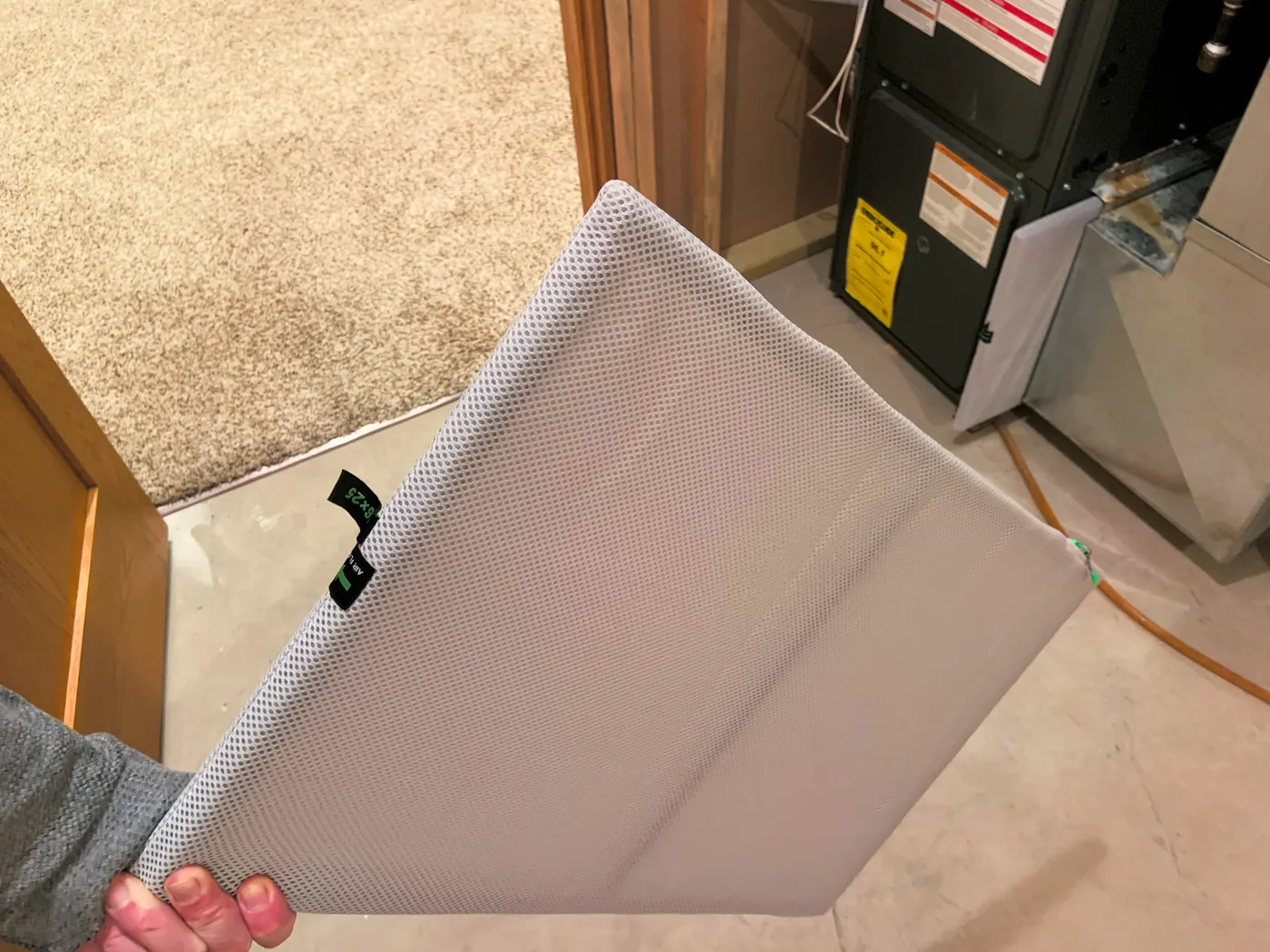
What to do. Slide it out of the slot on the furnace or air handler (or the return grille in the wall or ceiling) and hold it up to a light.
What you are looking for. If you cannot see light through it, it is done. Note the size printed on the frame and the arrow on the edge — the arrow points toward the furnace, in the direction the air travels.
What it means. A blocked filter is the single most common cause of weak airflow, a furnace that overheats and shuts off, and an AC coil that freezes into a block of ice. If the filter was badly clogged and the AC had been running, switch cooling off and leave the fan on for a few hours so the coil can thaw before you run it again. One-inch filters last one to three months; the thick four- or five-inch ones, six to twelve.
The thermostat
What to do. Check the screen is on, the mode is set to Heat or Cool (not Off), and the set temperature is a few degrees past the room temperature. If the screen is blank, change the batteries — most take two AA or AAA behind the faceplate.
What you are looking for. A schedule or Hold that has quietly moved the setpoint. The fan set to On instead of Auto, which blows unheated air between cycles and feels like a fault. On a heat pump, Emergency Heat left switched on, which keeps you warm and doubles the bill.
What it means. A surprising share of no-heat and no-cool calls end here. If the thermostat is fine and the system still does nothing, carry on down the list.
The furnace power switch
What to do. Look on the side of the furnace or on a wall or joist nearby for a switch that looks exactly like an ordinary light switch. Make sure it is on. Then check the blower door on the front of the furnace is pushed fully home.
What you are looking for. That switch gets knocked off by someone carrying a box through the garage more often than anyone would believe. The blower door has a safety switch behind it, and a door that is off or not quite seated makes the whole furnace play dead.
What it means. If the furnace comes back to life, you are done. If it starts and then stops again within a minute or two, something real is wrong and it is time to book.
The breakers and the outdoor disconnect
What to do. At the electrical panel, find the breakers for the furnace or air handler and for the outdoor unit — the outdoor one is usually a double-width breaker. Push a tripped breaker fully to Off, then back to On. Outside, check the grey box on the wall near the outdoor unit has its pull-out block pushed in the right way up.
What you are looking for. A breaker sitting in the middle position, which means it has tripped. A pull-out disconnect that a painter or landscaper removed and put back upside down, or not at all.
What it means. Reset once. If it trips again straight away, stop — that is the red section below, not a nuisance to be reset until it holds.
The outdoor unit
What to do. Switch the system off at the thermostat first. Clear leaves, grass clippings, cobwebs and anything stacked against the unit, so there is about two feet of open space all round and nothing on top. If the fins are matted with fluff, rinse them gently from the outside with a garden hose on a soft setting.
What you are looking for. Fins packed with cottonwood or dryer lint. A cover still on from winter. Shrubs grown in tight. In winter, a heat pump buried in snow or sitting in a solid shell of ice.
What it means. An outdoor unit that cannot breathe cannot shed heat, and the system either loses capacity or trips itself off on high pressure. Never use a pressure washer on it, never bend the fins, and never chip ice off a heat pump coil — let it defrost on its own.
The condensate drain
What to do. If the air conditioner or high-efficiency furnace has shut down and there is water near the indoor unit, find the white PVC drain line leaving it. Many have a small box or float switch on the line or in the drain pan, and a capped T fitting near the top. Pour a cup of distilled white vinegar into the T, and outside, hold a wet-dry vacuum tightly over the end of the drain line for a minute.
What you are looking for. Standing water in the pan, a float switch that has lifted, or a slimy blockage at the outlet. If the drain line runs to a small pump with a reservoir, check the pump has power and the reservoir is not full.
What it means. A blocked drain trips the float switch, which is designed to shut the system down before the pan overflows. Clear the blockage and the system usually restarts on its own. If it keeps happening, the line needs a proper flush and a look at the slope.
The vents and returns
What to do. Walk the house and make sure every supply vent is open and every return grille is clear of furniture, rugs, curtains and pet beds.
What you are looking for. Vents closed in spare rooms to "save money", a couch pushed over the return, a dresser sitting on a floor register.
What it means. Closing vents does not save anything on a modern system — it raises the pressure in the ducts, strains the blower, and can freeze the coil. Open everything up and give it a day.
One clean restart
What to do. Set the thermostat to Off, wait five minutes, and set it back. If a furnace still does nothing, flip the furnace power switch off for thirty seconds and back on.
What you are looking for. Furnaces lock themselves out after three failed ignition attempts and will sit silent for an hour or more. Cycling the power clears the lockout once.
What it means. If it starts and stays running, watch it for a day. If it goes straight back into lockout, the fault is real — usually a dirty flame sensor, an igniter or a pressure switch — and repeated restarts will not fix it.
Amber: look, do not touch
These are the things you cannot fix, but where noticing them — and telling us — turns a slow diagnosis into a quick one.
What to look at, and what to tell us when you book.
- The diagnostic light on the furnace. Look through the small window in the lower furnace door for a blinking LED. Count the flashes, note the pattern, and read the code chart on the inside of the door. That code is the most useful thing you can tell a technician. Do not take the burner door off to get a better look.
- Ice on the copper line or the indoor coil. Turn cooling off and leave the fan running so it can thaw — that can take several hours. Do not chip at it. Ice usually means either weak airflow (check the filter) or low refrigerant, and only one of those is yours to fix.
- An outdoor fan that hums but does not spin. Switch the system off at the thermostat and leave it off. Do not reach in or poke the blades with a stick to get it going. Nine times out of ten this is a failed capacitor, and it is a quick repair for someone with the meter and the part.
- A pilot light that has gone out. On an older furnace with a standing pilot, you may relight it once, exactly by the instructions on the label inside the door. If it will not light, or lights and goes out again, stop. That is a thermocouple or gas valve problem, and it is not a lighter-and-patience problem.
- Noises and smells. Note what it sounds like (a squeal, a grind, a bang on start-up, a clicking that never becomes a flame) and what it smells like (dusty at the start of the season is normal; burning plastic, hot electrical or sulfur are not). Describing it accurately gets it diagnosed faster.
- Water where water should not be. Note where it is coming from before you mop it up: the base of the indoor unit, the drain line, a rusty stripe down the furnace cabinet, or the humidifier. Each one points somewhere different.
Red: this is where it stops
Not because we want the work. Because the failure mode here is a fire, a poisoning or a shock, not a bigger bill.
The hard line, and why it is where it is.
- Anything to do with gas. If you smell gas, leave the house, do not touch any switches on the way out, and call your gas utility or 911 from outside. That comes before any HVAC company, including us. Gas valves, burners, the heat exchanger and the flue are not homeowner territory at any price.
- Anything to do with refrigerant. It is illegal to buy or handle without federal certification, the wrong charge damages the compressor, and a system that is low has a leak — adding more just pays for gas that escapes again. The DIY recharge kits sold online do more harm than the problem they claim to fix.
- The 240-volt side and the capacitor. The outdoor unit and most air handlers run on 240 volts, and the capacitor inside holds a charge that can seriously hurt you even with the breaker off. This is the one that puts people in the emergency room. The part is cheap online; the reason technicians still get called for it is not the part.
- A breaker that trips again. One reset is a check. A second trip is a message: a shorted motor, a failing compressor or a wiring fault. Holding it on or swapping in a bigger breaker is how equipment fires start.
- Anything behind the burner door or on the control board. If reaching it means removing more than the filter door and the blower door, it is past the line. Control boards are also the easiest part to destroy with a probe in the wrong place.
- A system still under warranty. Opening it up yourself can end the manufacturer cover on the parts, and on a newer system that may be the difference between a repair that costs you nothing and one that does not. Check before you pick up a screwdriver.
Done the green list and it is still not right?
Book the visit. We find the actual cause, you get the exact price upfront, and you approve it before any work starts.
Book a Visit60 seconds online · or call (206) 486-6373
What a technician does that you cannot
Almost none of it is secret knowledge. It is measurement. A capacitor is judged in microfarads against the number printed on its side. A flame sensor is judged by the current it passes, in microamps. A refrigerant charge is judged by pressures and temperatures together, not by a gauge alone. Airflow is judged by static pressure across the furnace. A heat exchanger is judged with a combustion analyzer and a carbon monoxide reading, not by eye.
Those instruments are what the visit pays for, and they are why a good technician can tell you not just what failed but the number that proves it. If you are ever told a part is bad, that number is the thing to ask for.
Our service areas
We run out of Covington and cover the greater Puget Sound area.
King County
Covington, Kent, Renton, Maple Valley, Auburn, Federal Way, Des Moines, Enumclaw, Bellevue, Issaquah, Sammamish, Bothell
Pierce County
Tacoma, Puyallup, Lakewood, Sumner, Bonney Lake
Snohomish County
Lynnwood, Everett
Not on the list? We cover the greater Puget Sound area around our Covington base. Book it and a technician confirms within 1 business hour.
Why homeowners hand it to us
- You approve the price first. Upfront quote before a single screw turns.
- We answer 24/7. Book in a minute, hear from a technician within 1 business hour.
- 500+ jobs done by 4.9★ rated, professional technicians.
- Fixed right, guaranteed. If it’s not right, we make it right.
Quick answers
Can I replace the capacitor myself? It is fifteen dollars online.
We would not. A capacitor stores a charge after the power is off and has to be discharged properly before it is touched; the replacement has to match the microfarad and voltage rating exactly, and a hum-but-no-spin symptom is not always the capacitor in the first place. When we replace one, we measure the old one first, so you are told the reading and the rating — that is the part you are paying for.
Can I clean the outdoor coil with a hose?
Yes, gently. Switch the system off at the thermostat, use an ordinary garden hose from the outside of the unit, and let it dry before switching back on. Never a pressure washer, never a stiff brush, and no harsh chemicals — the fins are thin aluminum and bend if you look at them wrong. A coil that is greasy or packed solid with cottonwood needs a proper coil cleaner and a technician.
Can I clear the condensate drain myself?
Yes. A cup of distilled white vinegar in the T fitting and a wet-dry vacuum on the outside end of the line clears most blockages. If it clogs again within a few weeks, the line has a low spot or a growth problem that needs a proper flush and a look at how it is routed.
Can I replace my own thermostat?
A like-for-like swap on a simple furnace or AC is within reach of most people: photograph the wiring before you disconnect anything and label each wire. Where it goes wrong is a heat pump, a two-stage system, or a smart thermostat on a system with no common wire — a mis-wired thermostat can blow the fuse on the control board and turn a twenty-minute job into a service call. If any of those describe your system, let us do it.
How long do I wait after the easy checks before I book?
If the system runs, give it a day and see whether it holds. If it did nothing, or it ran and then stopped again, book straight away — especially in a cold snap or a heat wave, when the schedule fills. Tell us which checks you did; it saves the technician repeating them and gets you to the actual fault faster.
Checked everything and it is still not right?
Book a visit. Honest diagnosis, exact price upfront, and you approve it before anything starts.
Book a Visit60 seconds online · or call (206) 486-6373
More from our site
Thermostat problems · Been told you need a part? · Furnace will not turn on · AC not cooling · AC frozen · Heating services · Cooling services