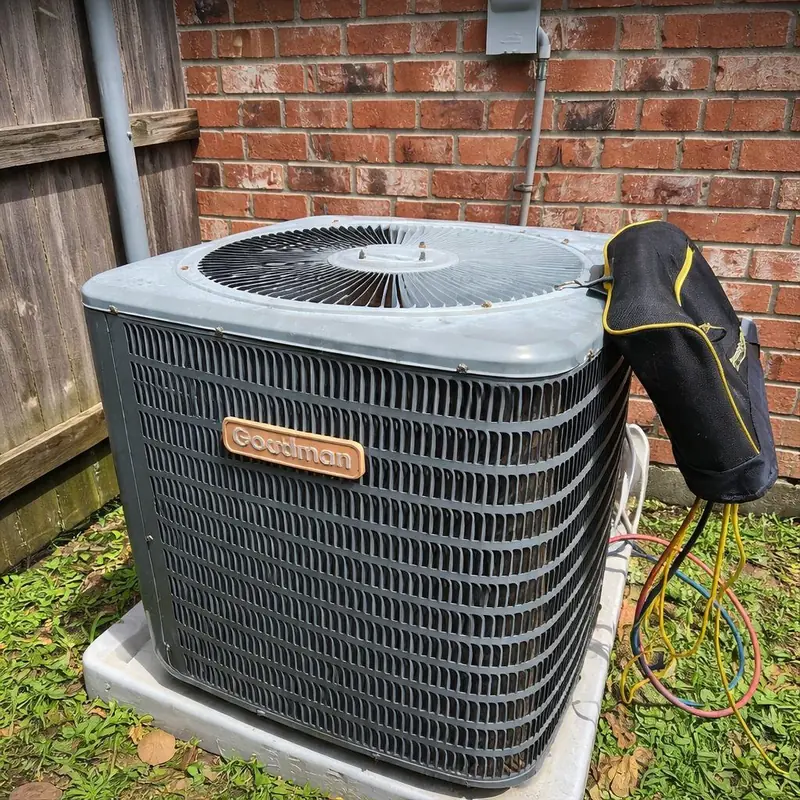
General information about how these parts fail and how a diagnosis is confirmed. Your system may differ, and nothing here replaces someone measuring your equipment. We are an independent contractor and not affiliated with any manufacturer.
What the part actually does
It matters more than people expect, because when it stops, other things start failing fast.
It pulls air across the outdoor coil
That is how your system dumps the heat it collected from inside the house. No airflow, nowhere for the heat to go.
When it stops, pressure climbs quickly
Within minutes the compressor is working against rising pressure and heat, which is why a failed fan turns into a much bigger conversation if it is left.
It has its own capacitor
On a dual capacitor, one side serves this motor. That side failing is the single most common reason a condenser fan will not spin, and it is a fraction of the cost of a motor.
On a heat pump in winter it is meant to stop
During a defrost cycle the outdoor fan switches off deliberately while the unit melts ice off its own coil. A still fan and a cloud of steam on a cold morning is normal operation, not a fault.
What is actually going on
Two things not to do
Both are suggested online and both are genuinely unsafe.
Do not push the blade with a stick
It is a real diagnostic and it is not for you
It requires the top panel off and the unit live. The blade starts under 240 volts. Technicians do this with the cabinet open and know exactly what is around them; from a homeowner position it is a hand next to a blade that is about to move.
Do not open the electrical compartment to look at the capacitor
It holds a dangerous charge with the power off
The capacitor that is probably your actual fault is the one part you must not go and inspect. Switching off the breaker does not discharge it.
What you can safely establish
All of this is from outside with everything closed up.
Is it a heat pump, and is it winter?
Rule this out first
If the fan is off, the coil is iced or steaming and the weather is cold, that is very likely a normal defrost cycle. Watch it for ten minutes. If the fan restarts and the steam clears, nothing is wrong.
Is the unit humming with the fan still?
Points at the capacitor, the contactor or a seized motor
Three possibilities, two of them cheap. This is the state that gets a motor quoted when a capacitor would have fixed it.
Any grinding, squealing or rattling?
That does point at the motor itself
Bearing noise is one of the few symptoms that genuinely indicates the motor rather than something feeding it.
Is the coil filthy?
A blocked coil makes a healthy motor overheat and cycle off
The motor has its own thermal protection. Clean the coil and a motor that appeared to be failing often stops cutting out. Power off at the disconnect, rinse gently from outside, do not open anything or bend the fins.
What should be checked before a motor is quoted
A motor quote with none of these established is a guess with a price on it.
The fan side of the capacitor
Measured against its printed rating
This is the number one cause of a condenser fan that will not spin and it costs a fraction of a motor. If nobody measured it, the diagnosis is not finished.
The contactor
Whether it is pulling in, and the state of its points
Pitted or welded points, or something physically lodged between them, stop the outdoor unit starting at all.
The wiring at the motor
Burnt, loose or chewed leads
Rodents get into outdoor units. So does water. Both produce a motor that will not run and a motor that is perfectly fine.
The blade itself
Whether it is fouling the shroud or set at the wrong height
A blade catching on something, or sitting at the wrong depth, will stall a good motor and overheat it.
If a motor is genuinely needed, which one
A generic replacement of the wrong speed, rotation or horsepower creates new problems
Wrong specification means high head pressure, noise and a short life. It is fair to ask what is going in and whether it matches what came out.
The trap that runs the other way, and costs the most
- A dead outdoor fan gets misread as a dying compressor. This is the expensive version of this fault. With no airflow over the coil, pressure and temperature climb until the compressor trips its own overload or a high pressure switch opens. The homeowner is then told the compressor is failing. Manufacturer and trade literature both list a bad outdoor fan motor, a bad fan capacitor, a blade at the wrong height, a blade turning backwards and a dirty condensing coil among the causes of exactly that trip. If you have been quoted a compressor, ask whether the outdoor fan was confirmed working.
- “The motor is not running” is not the same as “the motor failed.” Trade guidance says it plainly: wiring problems and failed capacitors will both stop a perfectly good motor, and replacing it will not help anything. The motor is where you end up after the cheaper things are ruled out, not where you start.
- A motor that cycles on and off is often telling you about the coil. It has internal thermal protection. If it is overheating because the condenser is packed with dirt, it will keep cutting out and restarting. Clean the coil first and the symptom frequently disappears.
- On a heat pump, check the season before anything else. A still outdoor fan in December with steam coming off the unit is a defrost cycle doing its job. It is worth ruling out before anyone is called.
This is almost always worth repairing
A condenser fan motor is a moderate cost part and replacing one is a straightforward job. It rarely justifies a conversation about a new system on its own. The exception worth being honest about is a system already past fifteen years that also needs a coil or a compressor — at that point you are stacking repairs onto equipment near the end of its life, and it is fair to put the numbers side by side. But a fan motor alone, on a system that is otherwise fine, is a repair.
Fan not spinning?
Book a visit. We check the capacitor and the contactor before anyone talks about a motor.
Book a Diagnostic Visit60 seconds online · or call (206) 486-6373
How it works when you book
- 1
Tell us what you were quoted, or do not — both work Some people would rather we came in cold. We diagnose it ourselves either way.
- 2
We measure it and show you the reading The number off the meter and the number printed on the part. If those two do not disagree, the part is not the problem.
- 3
You get the price in writing before anything starts Itemised, and you approve it. If the honest answer is that nothing needs replacing, that is what you get.
Our service areas
We run out of Covington and cover the greater Puget Sound area.
King County
Covington, Kent, Renton, Maple Valley, Auburn, Federal Way, Des Moines, Enumclaw, Bellevue, Issaquah, Sammamish, Bothell
Pierce County
Tacoma, Puyallup, Lakewood, Sumner, Bonney Lake
Snohomish County
Lynnwood, Everett
Not on the list? We cover the greater Puget Sound area around our Covington base. Book it and a technician confirms within 1 business hour.
Why homeowners hand it to us
- You approve the price first. Upfront quote before a single screw turns.
- We answer 24/7. Book in a minute, hear from a technician within 1 business hour.
- 500+ jobs done by 4.9★ rated, professional technicians.
- Fixed right, guaranteed. If it’s not right, we make it right.
Quick answers
The fan is not spinning but I can hear humming. What is that?
Something is being asked to start and cannot. Most commonly that is the fan side of the capacitor having failed. It can also be a contactor issue or a motor with seized bearings. The humming itself does not distinguish them, which is why it needs measuring rather than guessing.
My outdoor unit stopped and it is freezing outside. Should I worry?
If it is a heat pump, probably not. Defrost cycles switch the outdoor fan off deliberately while the unit clears ice from its own coil, and the steam that comes off looks alarming the first winter. Give it ten minutes and see whether it resumes.
Can I just buy a universal motor online?
You can, and it is one of the more common ways people create a new problem. Speed, rotation direction, horsepower and mounting all have to match, and a mismatch shows up as high pressure, noise and a motor that does not last. Beyond that it lives in a compartment with live high voltage terminals and a charged capacitor.
Should the capacitor be replaced at the same time as the motor?
Usually yes, and it is reasonable rather than an upsell. If a weak capacitor contributed to the motor failing, fitting a new motor to the old capacitor invites a repeat. The part is inexpensive relative to the labour of going back.
How long do these motors last?
There is no published field data on it, so we are not going to quote you a figure. What is fair to say is that they last a good deal longer when the coil is kept clean and the capacitor is healthy, because both of those are what makes them run hot.
Let us check the cheap thing first.
Book online in about a minute. If it is the capacitor, that is what we will tell you.
Book a Diagnostic Visit60 seconds online · or call (206) 486-6373
More from our site
AC repair cost · AC not cooling · All parts explained · Cooling services