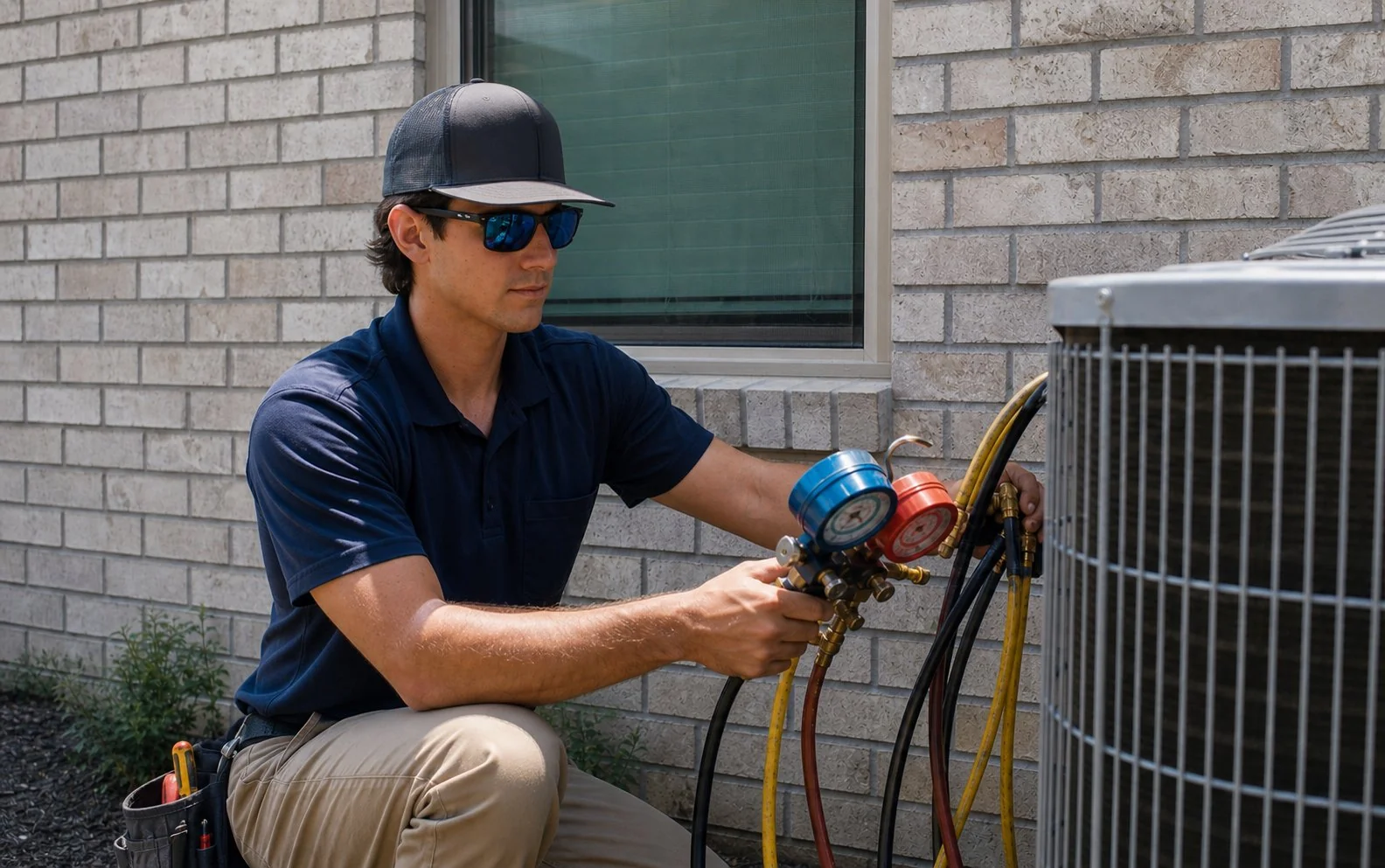
General information about how these parts fail and how a diagnosis is confirmed. Your system may differ, and nothing here replaces someone measuring your equipment. We are an independent contractor and not affiliated with any manufacturer.
What the part actually does
Worth thirty seconds, because understanding it is what lets you ask the right question.
It is a starting and running helper
It gives the compressor and the outdoor fan motor a phase-shifted push so they turn with the right torque in the right direction. Without a good one, motors struggle to start and run hot.
Most homes have a dual capacitor
Two capacitors in one can, with three terminals: one side serves the compressor, the other serves the fan, and they share a common. One side can fail while the other is fine.
It has a number printed on it
A rating in microfarads, often something like 45+5. That printed number is the whole basis of the test, and it is why you should always be shown two numbers rather than one.
It stores a dangerous charge
A capacitor can hold enough energy to hurt you badly after the power is off at the breaker. This is not a part to go and look at yourself. More on that below.
What is actually going on
The safety part, and we mean it
This is the one component on your system where curiosity is genuinely dangerous.
Do not open the electrical compartment
Switching the power off does not make it safe
A capacitor stores energy and can hold a dangerous charge long after the breaker is off and the outdoor disconnect is pulled. Manufacturers instruct technicians to discharge one through a resistor before handling it. This is not a job that becomes safe by being careful.
Do not push the fan blade with a stick
It is a real field test and it is not a homeowner test
You will find this suggested all over the internet. It puts your hand next to a blade that will start under 240 volts, inside an open cabinet that is live. Look at the fan through the grille from outside instead and note whether it is turning.
If the breaker trips again, stop
Once is reasonable. Twice is a fault.
A breaker that goes straight back is telling you something. On a system where a short could be inside the compressor, repeatedly resetting it makes the eventual repair worse and more expensive.
What you can safely notice from outside
All of this is done with the panels on and your hands nowhere near anything.
The unit hums but nothing spins
The classic capacitor symptom — and also the classic contactor symptom
Both produce exactly this. So does low voltage. So does a seized motor. The hum on its own does not tell you which, which is the entire point of this page.
It works in the morning and quits in the afternoon
Heat-related, and worth mentioning when you book
A part that works cold and fails hot points somewhere specific. Tell us the time of day it happens, because it genuinely narrows things down before anyone arrives.
Visible bulging or an oily residue on the can
That is a real sign, and it is the one thing you might see
A domed top or a split seam means it has failed. Ordinary surface rust does not, and is not a reason to replace anything.
The system is under ten years old
Then ask about the warranty before anything else
Parts warranties commonly run ten years to the registered owner. It costs nothing to ask and it changes the bill.
How a technician actually proves it — ask for this
There are two legitimate tests and both produce a number. If you are not given a number, you were not given a diagnosis.
The bench test
Meter across the terminals, compared against the printed rating
Power off, capacitor discharged, leads removed. The meter gives a reading in microfarads and the can has its rating printed on it. Those are the two numbers you should be shown.
The under-load test
Measured while the system is running
The technician clamps the start winding wire and measures voltage across the capacitor, then works the capacitance out from those readings. Goodman publishes the same formula in its own service manual. It is a real test and it also produces a number.
What actually counts as failed
Manufactured to about six percent. Most of the trade replaces at ten percent low.
These parts are built to a tolerance of roughly six percent. A 45 microfarad capacitor reading 44 is fine. Reading 40 is failing. Reading 20 is dead. Readings above the rating are usually a measurement artefact rather than a fault.
The question worth asking
What did it measure, and what is it rated for?
Any technician who has genuinely tested it can answer that in five seconds. It is not a hostile question and nobody competent minds being asked it.
Five things that get blamed on the capacitor
- The contactor. It is the electrical switch that lets the outdoor unit start. Pitted, burnt or welded contact points — or an ant sitting between them, which happens more than you would think — produce precisely the same humming, non-starting unit. Industry standards require inspecting and testing it. It should not be skipped on the way to condemning a capacitor.
- Low voltage coming into the unit. A motor that cannot start because the supply is weak trips its own overload and looks exactly like a capacitor fault. The trade guidance is blunt about it: fixing a voltage drop problem does more good than adding a hard start kit.
- The motor bearings. A fan motor that is seizing will refuse to start and will then destroy the capacitor trying. Replace the capacitor alone and you will be doing it again shortly.
- The direction of blame is usually backwards. People are often told a failing motor took out the capacitor. In practice it runs the other way far more often — a weak capacitor overworks and kills a motor. Which is why a capacitor caught early is a genuine save, and why it should still be measured rather than assumed.
- The hard start kit upsell. These are sometimes sold as reducing your startup current to protect the compressor. They do not reduce it and physically cannot. What they reduce is the time the motor spends struggling. They are legitimately specified for long line sets, certain metering devices, and low starting voltage. Sold as an amp-reducer, the claim is not true.
This part never justifies replacing the system
It is the cheapest component on your air conditioner and replacing one is a short visit. So if a conversation begins with a weak capacitor and ends with a quote for a whole new system, those are two separate conversations and they deserve to be treated as two. There is one thing genuinely worth asking about, though: if a capacitor has failed on a system only two or three years old, something caused that — heat, voltage, or a poor quality part — and if nobody finds out which, you will be buying another one. A good answer to “why did this fail?” is worth more than the part.
Been quoted a capacitor and want a second number?
Book a visit. We measure it, we show you the reading against the rating, and you decide.
Book a Diagnostic Visit60 seconds online · or call (206) 486-6373
How it works when you book
- 1
Tell us what you were quoted, or do not — both work Some people would rather we came in cold. We diagnose it ourselves either way.
- 2
We measure it and show you the reading The number off the meter and the number printed on the part. If those two do not disagree, the part is not the problem.
- 3
You get the price in writing before anything starts Itemised, and you approve it. If the honest answer is that nothing needs replacing, that is what you get.
Our service areas
We run out of Covington and cover the greater Puget Sound area.
King County
Covington, Kent, Renton, Maple Valley, Auburn, Federal Way, Des Moines, Enumclaw, Bellevue, Issaquah, Sammamish, Bothell
Pierce County
Tacoma, Puyallup, Lakewood, Sumner, Bonney Lake
Snohomish County
Lynnwood, Everett
Not on the list? We cover the greater Puget Sound area around our Covington base. Book it and a technician confirms within 1 business hour.
Why homeowners hand it to us
- You approve the price first. Upfront quote before a single screw turns.
- We answer 24/7. Book in a minute, hear from a technician within 1 business hour.
- 500+ jobs done by 4.9★ rated, professional technicians.
- Fixed right, guaranteed. If it’s not right, we make it right.
Quick answers
How long should a capacitor last?
Honestly, nobody knows in any published way. The rated lab life works out to somewhere around a decade at typical run hours, but that is a bench rating under ideal conditions, and there is no published field failure data for these parts at all. Anyone quoting you a confident five to ten year figure is repeating something they read rather than something that was measured.
Can I replace it myself? The part is cheap online.
We would rather you did not, and this is the one component where we would say that firmly rather than politely. It holds a dangerous charge with the power off, it lives in a compartment with live 240 volt terminals, and the correct procedure involves verifying the circuit is dead with a meter and bleeding the charge through a resistor. The part being inexpensive is exactly what tempts people, and it is not the part that hurts you.
The technician replaced it and it failed again a year later.
Then the capacitor was a symptom rather than the cause. Heat, low voltage, a struggling motor or a poor quality replacement part will all do this. Worth having someone look at why rather than simply fitting a third one.
Is a more expensive capacitor worth it?
A quality part from a known manufacturer, correctly rated, is worth having. Beyond that the differences are marginal. What matters far more is that the rating matches what your equipment calls for.
They said it was weak but the system is still cooling.
That can be a fair call and it can also be a soft sell. A capacitor measurably below its rating will run motors hot and shorten their life, so replacing it early is legitimate preventive work. The distinction is entirely whether a measurement was taken. Ask what it read.
Ask us what it measured.
Book online in about a minute. If the capacitor is fine we will tell you that, and we will show you the number either way.
Book a Diagnostic Visit60 seconds online · or call (206) 486-6373
More from our site
AC repair cost · All troubleshooting guides · All parts explained · Cooling services