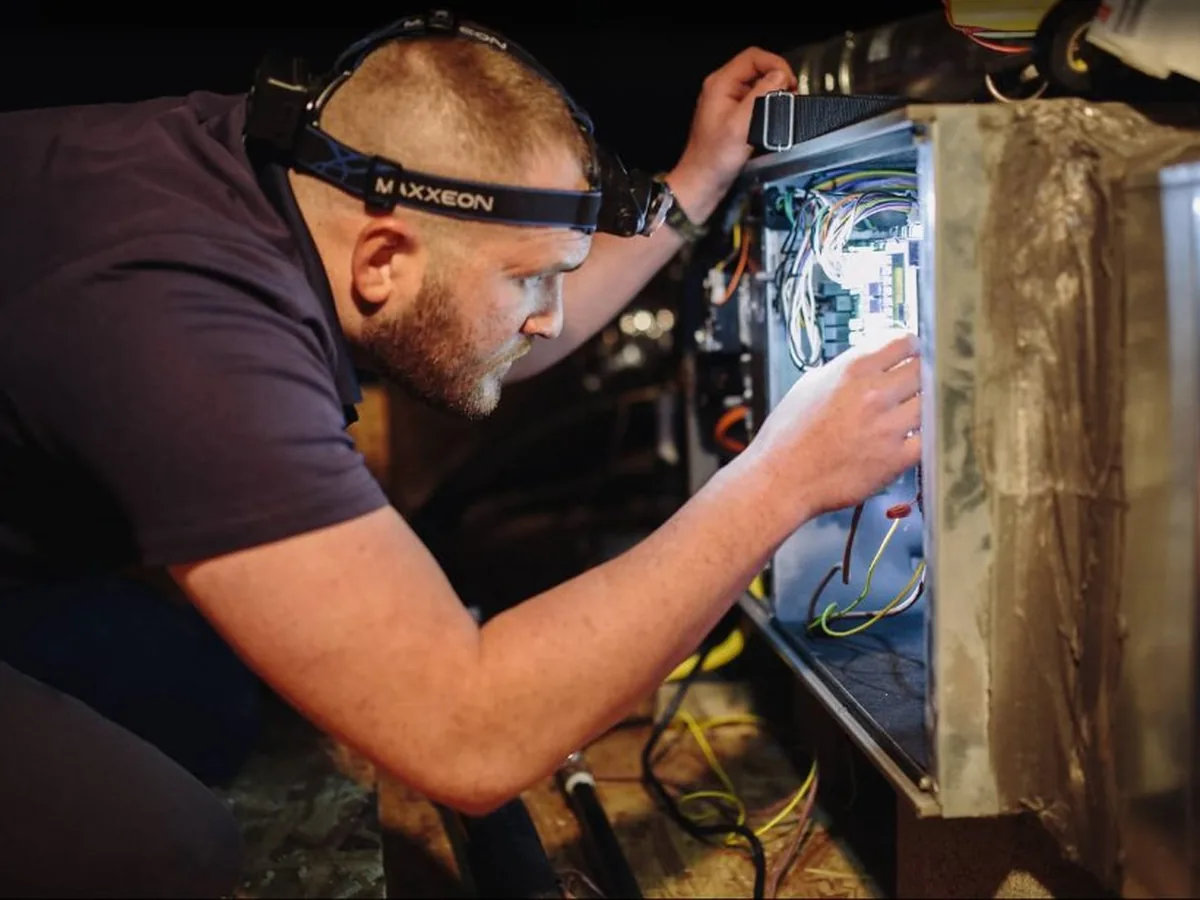
General information about how these parts fail and how a diagnosis is confirmed. Your system may differ, and nothing here replaces someone measuring your equipment. We are an independent contractor and not affiliated with any manufacturer.
What the part actually does
Understanding what it is for is what makes the two questions below obvious.
It is the furnace’s decision maker
It takes the call for heat from your thermostat, runs the ignition sequence in order, watches the safety switches, and starts the blower at the right moment.
It tells you what it thinks is wrong
The flashing light on it is a fault code, and the legend is usually printed inside the furnace door. That code is free diagnostic information sitting in your basement.
It refuses to run for good reasons
A great many “dead board” calls are a board correctly declining to start because a safety switch is open. That is the board working, not failing.
It carries a small fuse
Usually a three amp automotive style blade fuse. When that blows, the board appears completely dead — and the fuse blew because something shorted.
What is actually going on
The pattern to watch for
This is the sequence that ends with somebody being told they need a new furnace.
A board replaced without finding what killed it
It will fail again
The trade principle is worth quoting: fuses do not fail open on their own. Neither do boards. A low voltage wire rubbed through where it crosses a copper pipe, a chafed wire at a cabinet knockout, a miswired thermostat with exposed copper, water intrusion, a bad ground, rodents — something did it. Replace the board and leave the short in place and you have bought a very expensive fuse.
Two or more boards in one season
That means the underlying fault was never found
If you have replaced more than one, stop and insist on isolation diagnosis before a third goes in. There is a proper method for finding which circuit is shorting, and it is not guesswork.
Board, then inducer, then gas valve, then “you need a new furnace”
A recognisable sequence, and worth naming
Parts replaced one at a time across a winter, each failing to fix it, ending in a replacement quote. Sometimes that genuinely is how a difficult fault unfolds. Often it means nobody diagnosed it properly at the start. If you are two parts into that pattern, a second opinion costs far less than the third part.
Free information you can gather in five minutes
The flash code in particular is worth more than most people realise.
Count the flashes and write them down
Then photograph the legend inside the door
Something like three short flashes, a pause, then repeating. The legend printed on the door was written for your exact furnace. Between them, that tells you what the board believes is wrong, and often whether the explanation you are given is plausible.
The service switch and the breaker
The switch looks exactly like a light switch
It is often at the top of the basement stairs and gets flipped by accident more than anyone admits.
The furnace door properly latched
The interlock cuts power to the transformer
Which makes the board and the thermostat both go completely dead. Extremely common after a filter change.
The thermostat
Batteries, mode, and setpoint
A dead thermostat presents as a dead furnace, and it is the cheapest thing on this page to rule out.
The condensate drain
A blocked drain shuts some systems down entirely
Through a safety switch that many installers deliberately wire to kill everything, precisely so you notice.
The two questions worth asking
A board diagnosis that cannot answer these is not a diagnosis.
What input did you measure, and what output was missing?
This is the whole test
A board is judged by whether it produces the right output when it receives the right input. Someone who has genuinely tested it can tell you which signal went in and which one failed to come out. Someone who has not will answer in generalities.
What caused it to fail?
The question that saves you the second board
If there is no answer, the fault that killed the first board is still sitting in your furnace.
Was the fuse checked, and was the short found?
These are two separate things
A blown fuse makes a healthy board look dead. Fitting a new fuse without isolating the circuit that blew it just blows the next one, and the proper method is to test each circuit in turn to find which one is faulting.
Were the safety switches ruled out?
A board refusing to start is often correct
Pressure switch, limit switch, rollout switch, condensate switch, door switch. Every one of these produces a furnace that will not start, and none of them is a board fault.
Five things that look exactly like a dead board
- A blown fuse, and the short behind it. The board goes completely dark. The board itself is usually fine.
- A failed transformer. A weak or dead 24 volt transformer presents identically to a dead board, and it is a different and cheaper part.
- A pressure switch stuck open. From a cracked or clogged hose, a blocked flue, a plugged condensate trap on a high efficiency furnace, or ice at an outdoor drain termination. The board refuses to proceed, correctly.
- A limit switch open because the filter is filthy. The furnace overheated and shut down. That is the safety chain doing its job, and the board is reporting it rather than causing it.
- A rollout switch tripped. This one matters. It means flame went somewhere it should not, which is a combustion or venting problem and a genuine safety event. It is emphatically not a board fault and should never be treated as one.
When a board genuinely is worth replacing, and when it is not
The board itself is a middling cost part, and universal replacements exist for many models at less than the manufacturer part, though they are not always a straight swap. On a furnace under about fifteen years with a properly identified cause, replacing it is straightforward and sensible. On a furnace past twenty, a board plus the visit is real money going into an appliance already at the far end of its expected life, and it is fair to price a replacement alongside it rather than after it. What we would not do is quote you a board without telling you what killed it, because that is the version of this repair that comes back.
Been quoted a board?
Book a visit and tell us the flash code. We will tell you what the board is actually reporting.
Book a Diagnostic Visit60 seconds online · or call (206) 486-6373
How it works when you book
- 1
Tell us what you were quoted, or do not — both work Some people would rather we came in cold. We diagnose it ourselves either way.
- 2
We measure it and show you the reading The number off the meter and the number printed on the part. If those two do not disagree, the part is not the problem.
- 3
You get the price in writing before anything starts Itemised, and you approve it. If the honest answer is that nothing needs replacing, that is what you get.
Our service areas
We run out of Covington and cover the greater Puget Sound area.
King County
Covington, Kent, Renton, Maple Valley, Auburn, Federal Way, Des Moines, Enumclaw, Bellevue, Issaquah, Sammamish, Bothell
Pierce County
Tacoma, Puyallup, Lakewood, Sumner, Bonney Lake
Snohomish County
Lynnwood, Everett
Not on the list? We cover the greater Puget Sound area around our Covington base. Book it and a technician confirms within 1 business hour.
Why homeowners hand it to us
- You approve the price first. Upfront quote before a single screw turns.
- We answer 24/7. Book in a minute, hear from a technician within 1 business hour.
- 500+ jobs done by 4.9★ rated, professional technicians.
- Fixed right, guaranteed. If it’s not right, we make it right.
Quick answers
The furnace does nothing at all. Is the board dead?
Possibly, and there are several cheaper explanations that look identical: a blown fuse on the board, a failed transformer, the door switch not seated, the service switch off, or a safety switch open. All of them produce a furnace that does nothing.
What is the flash code and where do I find it?
A light on the control flashes a repeating pattern, visible through a small window in the furnace door. Count the flashes, note the pattern, and photograph the legend printed inside the door. It is the single most useful thing you can have ready before anyone arrives.
Can I fit a universal board myself?
We would not recommend it. Beyond the gas safety aspect, the wiring and the configuration have to match, and getting it wrong on equipment that controls a gas valve is not the place to learn. If the board is genuinely the fault, the short that caused it also still needs finding.
Why did my board fail?
That is exactly the right question and the honest answer is that it should be investigated rather than assumed. A wire rubbed through against copper pipework, water getting in, a poor ground, a surge, or rodents are the usual list. Boards do not generally die of old age.
They replaced the board and it failed again.
Then the original fault is still there. Insist on isolation diagnosis before a third one goes in — there is an established method for finding which circuit is shorting, and it should have been done the first time.
Tell us what it is flashing.
Book online in about a minute. The code in the notes changes what we bring and where we start.
Book a Diagnostic Visit60 seconds online · or call (206) 486-6373
More from our site
Furnace repair cost · Furnace will not start · All parts explained · Heating services