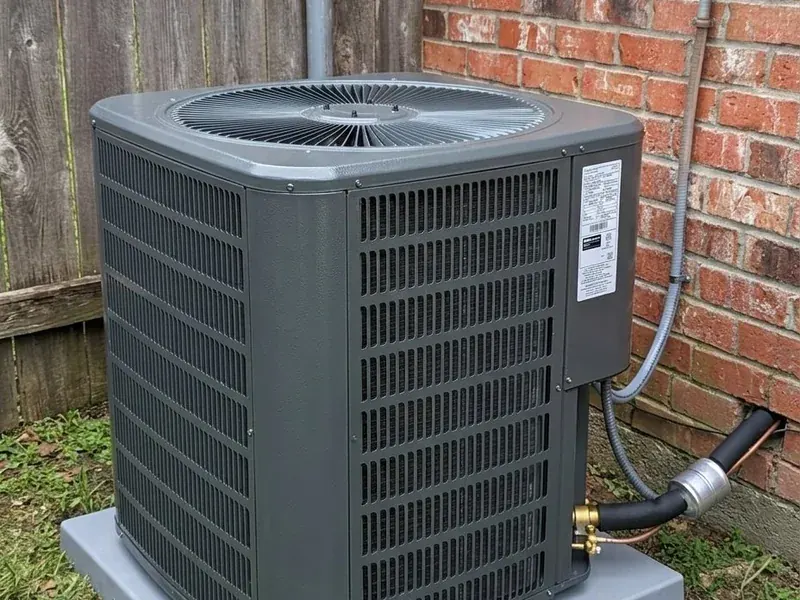
General information about how these parts fail and how a diagnosis is confirmed. Your system may differ, and nothing here replaces someone measuring your equipment. We are an independent contractor and not affiliated with any manufacturer.
What the part actually does
It is the pump at the centre of the system, and it is the reason this diagnosis is worth checking carefully.
It pumps the refrigerant
It is the motor and pump sealed inside the outdoor unit that moves refrigerant round the system. Everything else supports it.
It is the most expensive single part
Replacing one is recovery, brazing, a new filter drier, a deep vacuum and a full recharge, plus several hours of labour. On an older system that frequently approaches the cost of a new outdoor unit.
It protects itself
There is a thermal overload inside it that opens when it gets too hot and closes again when it cools. That single fact is behind the most common false condemnation in the trade.
It is usually the longest-warrantied part
Ten years to the registered owner is common, and twelve on some equipment. Before any other conversation, ask whether yours is still covered.
What is actually going on
Stop — two things that make this worse
Both of these turn a repairable situation into an expensive one.
Resetting the breaker over and over
Every reset can make the eventual repair worse
The trade guidance on this is unusually blunt: the breaker tripped for a reason, and if the short is inside the compressor, each reset adds carbon and acid into the refrigerant circuit. Reset once. If it goes again, stop and book somebody.
Approving a compressor with no stated cause
A compressor quote without a root cause is an incomplete quote
Compressors rarely die of old age alone. Low charge from a leak nobody found, a restriction in the line, a filthy condenser coil, a dead outdoor fan — any of these kill a compressor, and fitting a new one into the same conditions kills that one too. Ask what caused it. If there is no answer, that is worth pausing over.
The four hour test anybody can do
This is the most valuable thing on this page and it costs nothing.
If it hums for a few seconds and then clicks
That click is very often the internal overload, not a dead compressor
The protector inside has opened because the compressor is too hot. Manufacturers instruct technicians to let it cool for three to four hours and then retest. If you switch the system off at the thermostat, leave it alone for an afternoon, and it then starts and runs — the compressor was never the problem.
Feel whether the outdoor unit is unusually hot
A very hot shell supports the overload theory
Combined with the hum and click, that points at overheating rather than failure. What matters then is what made it overheat.
Look at the outdoor coil
A coil packed with cottonwood, grass clippings or dust causes exactly this
It is the most common reason a healthy compressor overheats and shuts itself down. With the power off at the disconnect, rinsing it gently from outside with a garden hose is safe homeowner work, as long as you do not open a panel or bend the fins.
Check whether the top fan is spinning
A dead outdoor fan will cook a compressor within minutes
If the fan is not turning while the unit is running, that is very likely your actual fault, and it is a far smaller repair.
What a real compressor diagnosis includes
There is an established order to this, and skipping to the compressor is skipping most of it.
The three cheap things, checked first
Capacitor, contactor, wiring
Capacitor measured against its rating; contactor points examined for pitting, burning or welding and checked for free movement; wiring compared against the diagram for burnt or loose connections. All three produce compressor-like symptoms and all three are inexpensive.
The low voltage controls
Many good compressors have been replaced because something upstream never let the contactor close
A pressure switch, a discharge line thermostat, a condensate float switch indoors, a corroded thermostat wire — any of these stop the compressor being asked to start at all. None should ever be bypassed to prove a point; the correct response is to replace the faulty one.
The supply voltage
Measured, not assumed
Undersized wiring, a failing breaker or a weak service extends start time and trips the overload. It presents identically and it is an electrical fix rather than a compressor one.
On a two-stage compressor, the plug
A dead diode in the stage plug makes a healthy compressor look weak
Two-stage units switch to full capacity through a separate plug that usually contains a diode. If it fails, the compressor never reaches high stage and gets written off as tired. The test is for 24 volts DC at that plug, and good compressors have been replaced for want of it.
On a heat pump, the reversing valve
A stuck valve can mimic a failing compressor
Manufacturer literature acknowledges that the standard pressure test cannot always tell the two apart on a single-phase system. It is a separate part with a separate diagnosis.
Four things worth knowing before you decide
- The overload reset is the big one. If the unit starts after several hours of being left off, you do not have a dead compressor — you have something that made it overheat. Dirty coil, failed outdoor fan, failed fan capacitor, wrong refrigerant charge or low voltage are the usual list.
- “Weak compressor” is a claim that should come with numbers. Amp draw against the rated load amps, and the pressures. A compressor genuinely losing capacity shows it in measurements. A verbal impression is not a diagnosis on a part this expensive.
- Technicians in the trade widely report that many warranty-returned compressors test good. We have looked for a published study behind that and could not find one, so we will not put a number on it. But it is a common enough observation in the trade to be worth knowing that this specific part gets condemned wrongly more than most.
- If it genuinely is the compressor, the diagnosis still is not finished. The question that matters is what killed it. Without that answer, a new compressor is an expensive way to buy the same failure again in a couple of years.
R-410A is not banned, and your system is not illegal to repair
This gets used to push replacements and it is worth being precise about. The Environmental Protection Agency states plainly that there are no requirements to stop using equipment currently in use, and that you can continue to repair an existing air conditioning or heat pump system — including replacing major components such as compressors and condensing units. Components used to repair existing systems are not restricted. The limits that came in for 2025 apply to newly manufactured products and new installations, not to fixing what you already own. As of this year there is no shortage of R-410A either; distributors have reported ample supply. What is true is that production is being wound down over the coming decade, so the cost of servicing an R-410A system will drift upward through the 2030s. That is a reason to factor age into a big repair decision. It is not a reason to be told your system is now unrepairable, because it is not.
Been quoted a compressor?
That is the one worth a second opinion. Book a visit and we will work through the cheaper causes first.
Book a Diagnostic Visit60 seconds online · or call (206) 486-6373
How it works when you book
- 1
Tell us what you were quoted, or do not — both work Some people would rather we came in cold. We diagnose it ourselves either way.
- 2
We measure it and show you the reading The number off the meter and the number printed on the part. If those two do not disagree, the part is not the problem.
- 3
You get the price in writing before anything starts Itemised, and you approve it. If the honest answer is that nothing needs replacing, that is what you get.
Our service areas
We run out of Covington and cover the greater Puget Sound area.
King County
Covington, Kent, Renton, Maple Valley, Auburn, Federal Way, Des Moines, Enumclaw, Bellevue, Issaquah, Sammamish, Bothell
Pierce County
Tacoma, Puyallup, Lakewood, Sumner, Bonney Lake
Snohomish County
Lynnwood, Everett
Not on the list? We cover the greater Puget Sound area around our Covington base. Book it and a technician confirms within 1 business hour.
Why homeowners hand it to us
- You approve the price first. Upfront quote before a single screw turns.
- We answer 24/7. Book in a minute, hear from a technician within 1 business hour.
- 500+ jobs done by 4.9★ rated, professional technicians.
- Fixed right, guaranteed. If it’s not right, we make it right.
Quick answers
The unit hums then clicks. Is the compressor dead?
Very often not. That click is characteristically the internal thermal overload opening because the compressor is too hot. Switch the system off at the thermostat, leave it for three or four hours, then try again. If it runs, the compressor is fine and something else caused the overheating — usually a dirty condenser coil or a dead outdoor fan.
Is it worth replacing a compressor or should I replace the system?
It turns almost entirely on two questions: is it under warranty, and how old is the system. Under warranty, repair usually wins easily because you are paying labour. Out of warranty on a system past twelve years or so, a compressor plus a full recharge often approaches what a new outdoor unit costs and does nothing about the age of everything else. We will quote both and put them side by side rather than steering you.
Someone told me my R-410A system cannot be repaired any more.
That is not correct. The EPA is explicit that existing systems can continue to be serviced and repaired, and that parts used for repairs are not restricted. What changed applies to new equipment. Ask anyone who tells you otherwise to show you where that requirement is written.
How do I know the diagnosis was real?
You should be able to be told the measured amp draw against the rated figure, the pressures, and what the technician believes caused the failure. On a part this expensive that is a reasonable thing to ask for, and any competent person can answer it.
Can I check anything myself?
Yes, and it is genuinely useful. Note whether the top fan is spinning, whether the unit is very hot, and what time of day it fails. With the power off at the disconnect you can rinse the outdoor coil from outside with a hose. Do not open any panel.
Get a second opinion before you spend that.
Book online in about a minute. Tell us what you were quoted, or do not — we will diagnose it from scratch either way.
Book a Diagnostic Visit60 seconds online · or call (206) 486-6373
More from our site
AC replacement cost · All parts explained · All troubleshooting guides · Cooling services