Next Phase Heating is an independent HVAC contractor. We are not an authorized dealer for, or affiliated with, any equipment manufacturer. Brand names are used only to identify the equipment we service. Codes vary by model and model year — the legend on your own furnace is always the last word.
First — the thing almost every article gets wrong
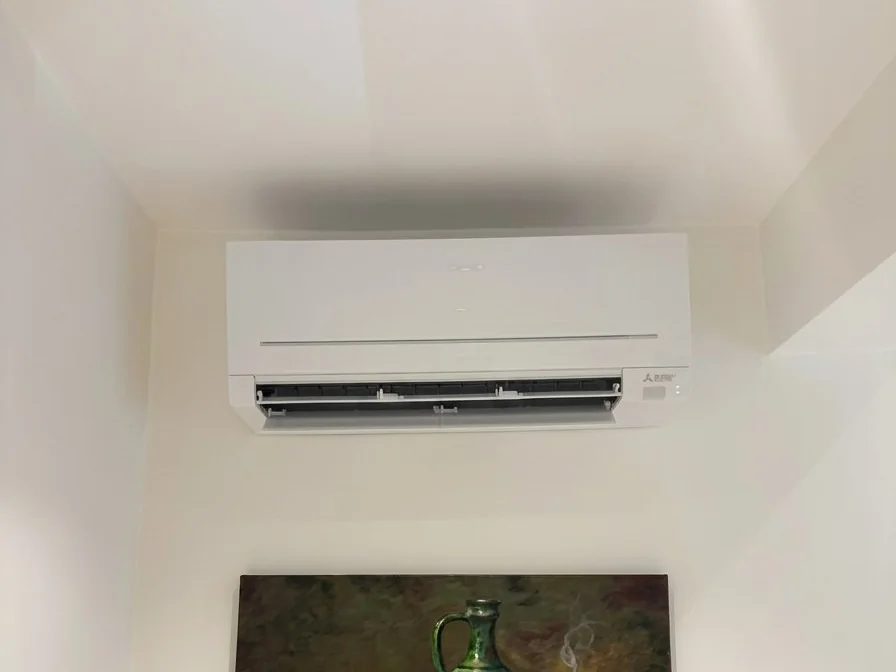
Mitsubishi’s residential M-Series and MXZ units do not display alphanumeric codes. Those belong to systems with a wired wall controller, which is mostly commercial equipment. Yours reports by blinking the operation lamp.
Blinking on its own is live indication
The unit found a fault while running and is telling you about it now. One set of meanings applies.
Blinking after you put it in recall mode is history
A stored fault, retrieved deliberately. A different set of meanings applies, and Mitsubishi’s manual carries an explicit note that the patterns in this mode differ from the live ones.
Some units have a wired controller instead
If you have a wall-mounted controller with a screen that shows CHECK and a two-character code, that is the alphanumeric system. It is a different diagnostic path and this page does not cover it.
Do not trust U-codes you find online
Lists of Mitsubishi U-codes are common on the internet. We could not verify a single one of them against a residential M-Series or MXZ manual — they appear to belong to the commercial Multi-S line. We would rather leave them off than guess.
What the blinks mean
Power it down and leave it down
One code on a Mitsubishi carries an explicit instruction from the manufacturer not to restart it.
14 or more blinks
Mitsubishi’s catch-all for other abnormality, and the one with a warning attached
The service manual attaches a hazard note to this one: there is a possibility of a diesel explosion due to air mixed into the refrigerant circuit, and it says not to start operation again without repair. That is the manufacturer’s wording, not ours. Shut it off at the breaker and leave it off.
Worth ten minutes, especially on a multi-zone
The most useful code on the whole Mitsubishi range is one the manufacturer answers with, in effect, go outside and look at the unit.
7 blinks, multi-zone outdoor
The electronics in the outdoor unit are overheating
Mitsubishi’s own remedy is to check around the outdoor unit and check its air passage. In practice that means leaves banked against it, a shrub that grew, snow drifted around it, or something stacked in front. This is the most genuinely homeowner-fixable fault on the brand.
5 or 6 blinks, multi-zone outdoor
Discharge temperature too high, or a high pressure condition
Mitsubishi points at the refrigerant circuit and the amount of refrigerant, and at the stop valve. The outdoor coil being caked with cottonwood or dust will push it this way too, so a look at the coil is worth doing. Beyond that it is a sealed system and it is ours.
Filters, before any of this
Two mesh filters behind the front flap on the indoor unit
They are washable, they take five minutes, and on a mini split a blocked filter causes more faults than any component does. If your unit is icing, dripping or not reaching temperature, do this before you count anything.
Needs a technician, but it is not an emergency
These are the live-indication meanings, which is what you are reading if the lamp started blinking on its own.
Steady blink, on and off evenly
The indoor unit has not heard from the outdoor unit for six minutes
Before assuming the worst, check the outdoor unit has power — these are often on their own breaker, and a tripped one presents exactly like this.
2 blinks
An indoor thermistor has failed
Either the coil sensor or the room temperature sensor. Small part.
3 blinks
The indoor fan motor is not reporting its speed back
Note this is the live meaning. In recall mode three blinks means something else entirely.
4 blinks
The indoor control board cannot read its own memory
A board fault.
5 blinks, single-zone
The compressor stopped on overcurrent or a start-up failure, three times in a minute
Mitsubishi also says to check the stop valve, which is worth knowing — a service valve left partly shut after an install does this.
6 blinks
An outdoor thermistor has failed
Again, the live meaning. In recall mode six blinks is the i-see sensor on the models that have one.
7 blinks, single-zone
The outdoor control board cannot read its own memory
Different from the multi-zone seven, which is the overheating one above. Which unit you have decides which applies.
Lamp on steady, not blinking
Outdoor control system fault — the outdoor unit is not running
On a Mitsubishi a steady lamp is not the healthy state it is on some other brands.
Four ways a Mitsubishi blink gets read wrong
- The same count means different things in the two modes. Three blinks is the indoor fan motor when the unit is complaining on its own, and the communication link when you have put it into recall. Six is an outdoor thermistor live, and the i-see sensor in recall. Mitsubishi prints a note in its own manual saying the patterns differ between the two. If you do not know which mode you are in, you do not have an answer.
- A three second steady light before the blinking is telling you something. In recall mode, if the lamp comes on solid for three seconds with no beep before it starts blinking, the fault is in the outdoor unit rather than the indoor one. It is easy to miss and it changes where a technician starts.
- Leaving recall mode switched on stops the unit working properly. Mitsubishi is explicit: release the failure mode recall when you are done, or the unit cannot operate properly. Power off, power on, then press reset. People put their unit into check mode, walk away, and conclude they have broken it.
- P8 is not low refrigerant. On the systems that do show alphanumeric codes, P8 gets described online as a refrigerant fault constantly. Mitsubishi’s own field guidance says otherwise — it is usually the outdoor unit having no power, a broken or crossed communication wire, or a voltage jumper set wrong. Mitsubishi thought this was worth a bulletin of its own.
Anything that involves refrigerant is not a do-it-yourself job, and that is federal law rather than our opinion
A fair few mini split faults point at the sealed system — low charge, a leak, a pressure or discharge temperature fault. Opening a refrigerant circuit legally requires EPA certification, and the reason is that these systems now run refrigerants with real handling requirements. There is no gauge set you can borrow that makes this a weekend job. What you genuinely can do is the filters, the outdoor coil, and clearing whatever has grown or drifted around the outdoor unit — and those three account for a surprising share of the calls we get.
Counted the blinks and it is not the filter?
Book it and tell us the count, and whether it was blinking on its own or in check mode. That alone saves a visit.
Book a Mini Split Diagnostic60 seconds online · or call (206) 486-6373
How it works when you book
- 1
Get the code before you cut the power On a mini split the code often lives in a recall mode that a power cycle wipes. Read it first.
- 2
Book online and tell us what it showed Takes about a minute. Say whether it was blinking on its own or you put it into a check mode.
- 3
You get the price before we start Diagnosed, explained, and quoted in writing. Nothing happens until you say go.
Our service areas
We run out of Covington and cover the greater Puget Sound area.
King County
Covington, Kent, Renton, Maple Valley, Auburn, Federal Way, Des Moines, Enumclaw, Bellevue, Issaquah, Sammamish, Bothell
Pierce County
Tacoma, Puyallup, Lakewood, Sumner, Bonney Lake
Snohomish County
Lynnwood, Everett
Not on the list? We cover the greater Puget Sound area around our Covington base. Book it and a technician confirms within 1 business hour.
Why homeowners hand it to us
- You approve the price first. Upfront quote before a single screw turns.
- We answer 24/7. Book in a minute, hear from a technician within 1 business hour.
- 500+ jobs done by 4.9★ rated, professional technicians.
- Fixed right, guaranteed. If it’s not right, we make it right.
Quick answers
How do I put my unit into the recall mode?
On the handheld remote, hold the operation select button and the temperature up button together, then press reset. Release reset first, keep holding the other two for another three seconds, and the display fills with everything at once. Then point the remote at the indoor unit and press the on-off button. A short beep confirms it heard you. When you are finished, power the unit off and on and press reset to come back out — that last step matters.
Can I still use my mini split with a code showing?
It depends entirely which one. Fourteen or more blinks is the one Mitsubishi tells you not to restart, and we would take that seriously. A communication fault or a failed thermistor is not dangerous, though the unit will usually refuse to do much anyway. Anything to do with the compressor stopping on protection is worth not repeatedly retrying, because each retry is hard on it.
Do you have to be a Diamond Contractor to work on a Mitsubishi?
No. Mitsubishi’s warranty excludes repair by anyone other than a licensed contractor — licensed, not Diamond. Servicing is not restricted and using us does not affect your warranty. The one thing the Diamond programme genuinely changes is the length of the registered warranty on a new installation, which is twelve years through a Diamond Contractor against ten otherwise. That only matters at the point of installing new equipment, not for a repair.
My multi-zone has one room not working and the rest are fine.
That is usually good news, because it points at that indoor unit or its branch rather than at the outdoor unit and the compressor. Worth saying when you book, because it changes what we look at first.
The outdoor unit is steaming in winter. Is that a fault?
No, that is a defrost cycle and it is meant to happen. A heat pump periodically runs backwards to melt the ice off its own outdoor coil, and the steam is that ice going. It looks alarming the first winter and it is entirely normal.
Tell us the count and the mode.
Book online in about a minute. Put the number of blinks in the notes and say whether the unit was doing it by itself.
Book a Mini Split Diagnostic60 seconds online · or call (206) 486-6373
More from our site
Mini split repair cost · Mini split services · All troubleshooting guides · Emergency mini split repair