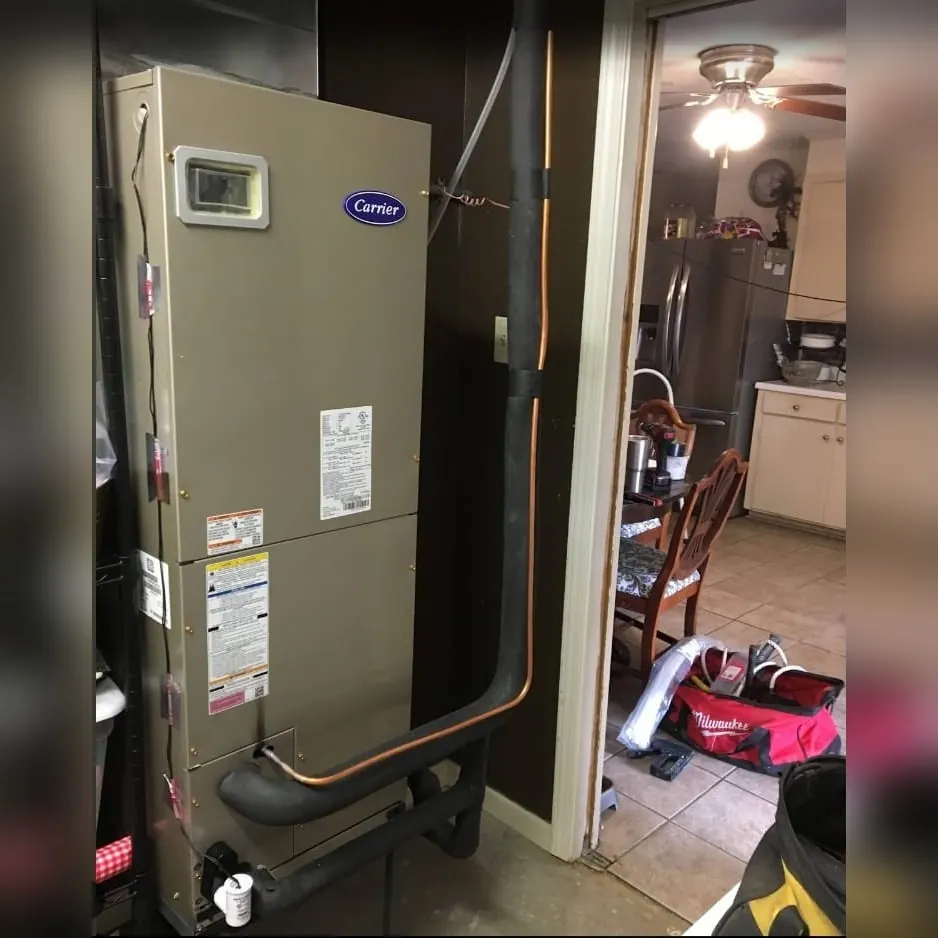
Next Phase Heating is an independent HVAC contractor. We are not an authorized dealer for, or affiliated with, any equipment manufacturer. Brand names are used only to identify the equipment we service. Codes vary by model and model year — the legend on your own furnace is always the last word.
First — how a Carrier code is actually built
This is not a simple flash count. Every code is two digits, and the two digits are told apart by the length of the flash.
Short flashes are the first digit
Count the quick ones. Three short flashes means the code starts with a 3.
Long flashes are the second digit
Then count the slow ones. Three short followed by one long is code 31, not 13 and not four flashes.
A light that is simply on is good news
Continuously on means the control has power and has nothing to report. This is normal, and it is reported as a fault more often than almost anything else.
A light flashing rapidly is not a code at all
Rapid flashing means line voltage polarity is reversed, or on twinned furnaces that the transformers are out of phase. Do not try to count it.
What the codes mean
Stop, and call someone
Gas and flame faults. Carrier builds a three hour auto-reset into some of these, which means the furnace may well start again on its own. That is not the same as the problem being fixed.
22
A flame was proved while the gas valve was de-energised
The control saw a flame it had not asked for. Shut the furnace off at the service switch. If there is any smell of gas, leave and call the gas company first.
33
The limit circuit is open — and the flame rollout switch sits in that circuit
Older Carrier literature words this one plainly as the limit or flame rollout switch being open. If a dirty filter caused it, changing the filter and letting it cool will clear it. If the rollout switch caused it, that switch has to be reset by hand and it will not come back on its own — which is a useful test in itself. A furnace that will not restart after a 33 has almost certainly rolled out.
13
Limit circuit lockout — the same fault as 33, but it has now given up
A 33 becomes a 13 after about three minutes. It clears itself after three hours and tries again. If your furnace is running in a cycle of working for a while and then stopping, this is very often what is happening, and it will keep happening until somebody finds out why.
21
Gas heating lockout, and this one does not reset itself
Unlike 13 and 45 there is no automatic recovery on a 21. It usually means the gas valve relay has stuck or the valve is miswired. It stays locked out until it is dealt with.
Worth ten minutes before you book
Two codes here are genuinely often the homeowner’s to clear. The rest of this group depends on which furnace you have.
33 after a filter change
The furnace overheated because it could not move enough air
Change the filter, open every supply register, and pull anything stacked against the return. Give it half an hour to cool. If it lights and runs, that was it. If 33 comes straight back, see the note above about the rollout switch.
31
A pressure switch did not close, or opened again mid-cycle
On a high-efficiency furnace, go outside and look at the white intake and exhaust pipes. Nests, snow and bags over the ends all cause this. Be aware that 31 means slightly different things across the Carrier range — on some it is the high-heat switch, on the modulating models it can be the medium or high switch, and on the Ultra Low NOx furnaces there is no pressure switch at all but a transducer instead.
32
The low-heat pressure switch did not close, or reopened
Two-stage and modulating furnaces only. Same outdoor check as 31.
Needs a technician, but it is not an emergency
Parts at the end of their life, mostly. None of these are dangerous.
14
Ignition lockout — it tried to light and could not
Auto-resets after three hours and has another go. If it is locking out repeatedly you are into igniter, flame sensor or gas supply territory.
34
Ignition proving failure
The burner lit, but the control could not confirm it stayed lit. Very often a flame sensor with a film on it, which is a small and quick fix.
23
The pressure switch did not open when it should have
The opposite problem to 31. Usually a stuck switch.
24
The secondary voltage fuse has blown
Something shorted. Fitting a new fuse without finding the short just blows the new one.
41
The variable-speed blower is reporting a fault
Turning below 250 RPM, or the board has lost communication with it entirely.
42
The inducer motor is reporting a fault
Present on the modulating and Ultra Low NOx models rather than across the whole range.
45
Control circuitry lockout
The board has caught a fault in itself. It clears after an hour and tries again.
15 · 25 · 35
Blower lockout, a setup or model selection error, or a modulating gas valve fault
These only appear on particular product lines. A setup error usually means somebody has configured the board wrongly rather than anything having broken.
Five ways a Carrier code gets read wrong
- Getting short and long the wrong way round inverts the code. 13 becomes 31, 23 becomes 32, 14 becomes 41, 34 becomes 43. Every one of those pairs is an unrelated fault, and the worst case is the first: 13 is a limit and rollout lockout, 31 is a pressure switch. If you are not certain which flashes were short, you do not have a code yet.
- Code 12 is not a fault, and neither is 11. Carrier’s own manual labels 12 as normal operation — it means the blower ran after power was restored. 11 means the fault memory is simply empty. Both get reported as problems regularly.
- Do not take the blower panel off. Carrier prints the instruction in bold: remove the main furnace door first, do not remove the blower access panel. That panel has the safety switch behind it, and pulling it drops the power and the stored code with it.
- A furnace that fixes itself after a few hours has not fixed itself. Codes 13 and 45 auto-reset after three hours, 14 likewise. The furnace coming back to life on its own is the design working, not the fault clearing.
- The Ultra Low NOx models are a different chart. Those furnaces use a pressure transducer rather than pressure switches, which changes what 23 and 31 mean and removes 33 from the list entirely. If your furnace is a low-NOx model, the label on the door is the only chart worth reading.
There is no error code for a cracked heat exchanger
It gets searched constantly and it gets used in sales conversations constantly, so it is worth being direct: no Carrier or Bryant control board can detect a cracked heat exchanger, and neither can any other manufacturer’s. The code does not exist. What the board can report is that the limit circuit opened, or that a flame was proved when it should not have been, and those can be downstream consequences of a failed exchanger. The crack itself is found by taking the furnace apart and looking, with a camera and a combustion analyser. If a replacement quote turns up on the strength of a flash code alone, that is a good moment to get a second number before you spend anything.
Counted the shorts and the longs?
Book the visit and put the code in the notes. It tells us what to load in the van before we set off.
Book a Furnace Diagnostic60 seconds online · or call (206) 486-6373
How it works when you book
- 1
Read the code before you reset anything The moment you cycle the power the live code is gone. Count it twice and write it down.
- 2
Book online and tell us what it showed Takes about a minute. Put the code in the notes — it changes what the technician loads into the van.
- 3
You get the price before we start Diagnosed, explained, and quoted in writing. Nothing happens until you say go.
Our service areas
We run out of Covington and cover the greater Puget Sound area.
King County
Covington, Kent, Renton, Maple Valley, Auburn, Federal Way, Des Moines, Enumclaw, Bellevue, Issaquah, Sammamish, Bothell
Pierce County
Tacoma, Puyallup, Lakewood, Sumner, Bonney Lake
Snohomish County
Lynnwood, Everett
Not on the list? We cover the greater Puget Sound area around our Covington base. Book it and a technician confirms within 1 business hour.
Why homeowners hand it to us
- You approve the price first. Upfront quote before a single screw turns.
- We answer 24/7. Book in a minute, hear from a technician within 1 business hour.
- 500+ jobs done by 4.9★ rated, professional technicians.
- Fixed right, guaranteed. If it’s not right, we make it right.
Quick answers
Is a Bryant furnace the same as a Carrier?
For diagnostics, yes. Same parent company, same control boards, and the manuals for the equivalent models use word-for-word identical language on the codes. Anything on this page applies to both.
The light is just on and not flashing. Should I worry?
No, that is the good one. Continuously on means the control has 24 volts and nothing to report. A light that is completely off means it has no power at all, which is worth looking at.
My furnace runs for a few hours then stops, then starts again later.
That pattern is the three hour auto-reset doing its job, and it usually points at a 13. The furnace is not recovering, it is being given another try on a timer. The underlying fault is still there and it is worth catching before a genuinely cold night.
Where do I find the code legend for my exact furnace?
On a service label. Carrier puts it in slightly different places depending on the model — the back of the main door on some, the blower access door on others, and Bryant words it as the control door. Whichever yours has, it was written for your furnace and it beats any chart online.
Will using you affect my Carrier warranty?
No. Carrier’s warranty asks that the furnace is installed and worked on by a licensed HVAC technician, not by a particular dealer. The one thing worth knowing is that warranty parts are credited back through a distributor, so we will tell you honestly if a part you need is better claimed than bought.
Tell us the code and we will bring the part.
Book online in about a minute. Put the two digits in the notes, and say which flashes were short.
Book a Furnace Diagnostic60 seconds online · or call (206) 486-6373
More from our site
Furnace repair cost · Igniter replacement cost · All troubleshooting guides · Heating services · Emergency furnace repair